How to sell wholesale and retail from one website — without showing trade prices to everyone
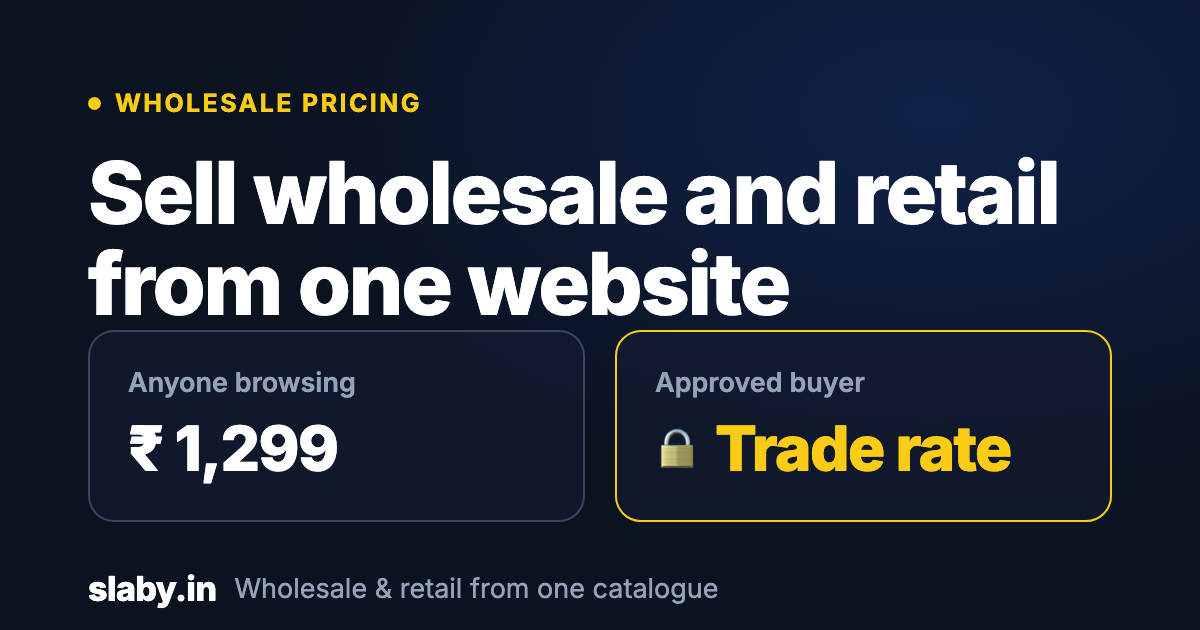
Ask a distributor in Madurai or Surat why they have no website and you tend to get the same answer: the moment trade rates go online, every competitor in the district has your price list. So the catalogue stays in a PDF, the rates stay on WhatsApp, and the business stays invisible to anyone searching for what it sells.
The instinct is right. Publishing trade prices openly is a real commercial risk. But the conclusion — no website at all — costs more than it saves, and it is not the only option available.
The actual problem is not pricing. It is audience.
A wholesaler does not have one price. They have a retail price anyone may see, a trade price for approved buyers, and often a specific rate for particular customers who have earned it.
Ordinary website software assumes one price per product, visible to everyone. Two prices means two websites, or a website plus a PDF, or a website that quietly shows the wrong number to the wrong person. None of those are good.
What you want is one catalogue where the PRICE depends on who is looking.
What gated pricing looks like in practice
A visitor who has not signed in sees your products, your photographs, your specifications and your retail price. They can buy at retail if you allow it. What they cannot see is your trade rate — not in the page, not in the source, not in an API response.
A buyer you have approved signs in and sees the trade price on the same pages. Nothing else changes for them: same catalogue, same URLs, same search.
A buyer who has requested access but has not been approved sees the retail experience and a way to ask. You approve or decline from your admin.
- One catalogue, maintained once.
- Trade rates never reach an unapproved browser — the price is not hidden with CSS, it is never sent.
- You decide who is approved, and you can revoke it.
- Specific buyers can have their own negotiated rates on top of the general trade price.
Why the distinction matters: There is a real difference between a price that is hidden and a price that is never sent. Anything hidden in the browser can be read by anyone who opens developer tools. If your trade rates are being hidden rather than withheld, they are already public — you just cannot see who has taken them.
Setting it up
- 1
Put your catalogue in once
Add products with both prices: the retail price anyone may see, and the wholesale price only approved buyers will. If you already keep a price list in a spreadsheet, import it rather than retyping it.
- 2
Decide what the public sees
Some sellers show retail prices openly and gate only trade rates. Others run a pure trade catalogue where no price shows until a buyer is approved. Both are normal; the second suits businesses that do not sell to consumers at all.
- 3
Open a way to request access
Buyers ask for trade access from your storefront — typically with their firm name and GST number. The request lands in your admin with everything you need to decide.
- 4
Approve the buyers you know
Approval is the whole gate. Approve the shops you already supply, and new buyers once you have checked them out. A declined or pending buyer simply keeps seeing the retail experience.
- 5
Add per-buyer rates where you have them
Most wholesalers have customers on special terms. Set those rates against the specific buyer and they see their price, not the general trade price, without any of it being visible to anyone else.
What this changes commercially
The immediate change is that you become findable. A catalogue that search engines can read brings buyers who were previously searching for your products and finding somebody else.
The quieter change is order quality. When a buyer can see stock, minimum order quantities and pack sizes themselves, the WhatsApp conversation stops being twenty messages of 'is this available' and starts being a confirmed order. Sellers usually notice this before they notice the new customers.
Common questions
- Can competitors just sign up and see my trade prices?
- Only if you approve them. Requesting access is not the same as having it — an account with no approval sees exactly what an anonymous visitor sees. Since you approve each buyer yourself, and can revoke it later, a competitor signing up gets nothing.
- Do I have to show retail prices at all?
- No. You can run a trade-only catalogue where products, photographs and specifications are public but no price appears until a buyer is approved. That keeps you findable in search without publishing a single rate.
- What if different customers pay different rates?
- That is normal in wholesale and it is supported directly. You set a rate for a specific buyer and they see theirs; everyone else sees the general trade price. You can also set quantity breaks so a larger order gets a better unit rate automatically.
- Will my trade prices show up in Google?
- No. Search engines crawl as anonymous visitors, so they see the public catalogue exactly as an unapproved buyer would. Your products get indexed; your trade rates do not.
- Can I sell to consumers and businesses at the same time?
- Yes, and it is one of the main reasons to run it this way. The same product page serves a consumer at retail and an approved shop at trade, so you maintain one catalogue instead of two storefronts.
- How long does it take to set up?
- The store itself takes minutes. The real work is your catalogue — if it is already in a spreadsheet it can be imported, and if it is in a PDF price list it usually needs to be converted first.
Worth being honest about
Gated pricing is not a substitute for knowing your buyers. The gate is only as good as your approvals, and approving anyone who asks defeats it entirely. Sellers who get value from this treat approval the way they treat opening a credit account.
It also does not remove WhatsApp from your business, and it should not. Indian trade runs on it. What changes is what the conversation is about: fewer questions about availability and rates, more actual orders.
Read next
- wholesale pricing
- B2B ecommerce
- distributor website
- trade pricing
- gated pricing
- India